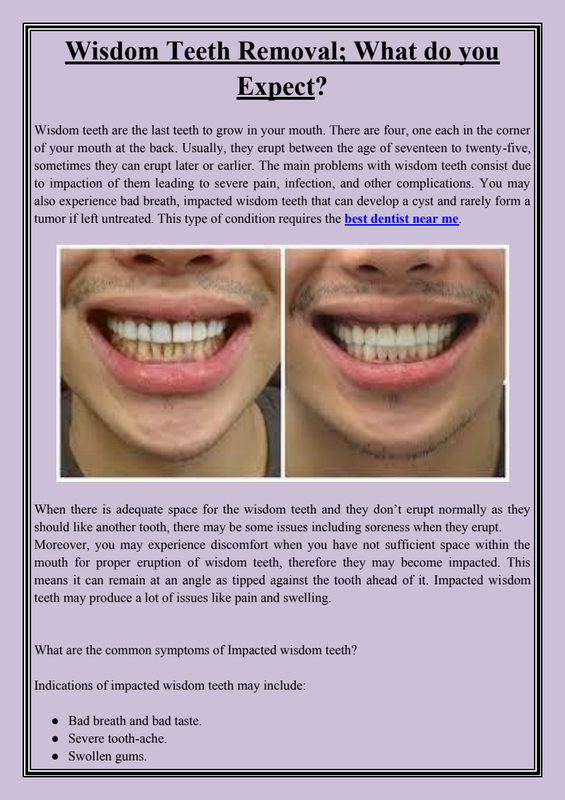
The impacted wisdom teeth remain associated with the gums usually. The reason may be the overcrowding. Normally, they don’t cause any severe problem but when mesioangular impaction causes, you may experience swelling and pain in the wisdom teeth. Moreover, sometimes wisdom tooth pain is so severe that you won’t be able to open the mouth easily. You may also feel bad breath, bad taste in the mouth. Another prompt condition that is common during such a condition is pericoronitis.
It is a wisdom tooth infection that may arise because of surrounding tissues of the tooth that are not completely outside the gums and are not properly located at their right position. This situation may also end in pain, bad breath, trismus, and inflammation also. Most dentists believe that it will be better for the teeth to remain completely buried so that they won't cause any pain. Visit the Emergency Dental Clinic Near Me if you have impacted wisdom teeth to avoid further consequences.
Why does one have teeth that are impacted?
However, they grow like other teeth, they may take a long duration to get erupted and be the last to emerge. Sometimes the size is very small resulting in overcrowding of the teeth as there will not be enough space for wisdom teeth to erupt. As a result, they become inclined, twisted, and displaced ending in impacted teeth.Impacted Wisdom teeth symptoms:
You will have:- Bad breath
- Softness in the gums and jawbones
- Inflammation on the jaw
- Bad taste
- Swelling in the lymph nodes
- Development of tumors
- Difficulty while opening the mouth.
Diagnosis:
Your dentist will make a deep evaluation of your teeth and mouth to determine the real cause of your wisdom teeth or if another condition is creating the oral problems. The evaluation may consist of:- Questions about the dental symptoms and general health.
- An evaluation of the condition of your teeth and gums.
- Dental x-rays to find out whether you have impacted teeth or not. Also, it will help those whether there are any signs of teeth or bone damage.

Wisdom teeth removal:
Impacted wisdom teeth, causing pain or other oral problems are generally extracted surgically. During Wisdom Teeth Removal Near Me, your oral surgeon makes an incision in your gums and eliminates the bone that blocks access to the impacted tooth root. After eliminating the tooth the dentist or oral surgeon closes the wound with stitches and packs the socket with gauze.
Wisdom Teeth Extraction may end in some pain, bleeding, and swelling as well as in the jaw. You may experience some issues in opening the mouth temporarily due to inflammation in the jaw muscles. You will be recommended to take care of your wounds and some pain medications. You may use cold compresses to decrease swelling.
If your wisdom teeth are causing oral issues, make an appointment with an oral surgeon to get them extracted, if required.Article Source : https://jeffreylinda.blogspot.com/2021/08/impacted-wisdom-teeth-extraction-why-is.html

When is dental deep cleaning necessary?
If there is bacteria development in your mouth, or plaque, or any other oral issues, your dentist will surely recommend a routine dental cleaning. When dental deep cleaning is performed by a dentist, he/she first focuses on the removal of the plaque that has been deposited on the upper or lower parts of the gums, and after that, he/she will perform root planning. It includes the process of polishing rough areas on the roots of the tooth in order to ensure that teeth are firmly fixed on the gums.However, this type of deep cleaning teeth only depends on the recommendation of the dentist after the proper diagnosis of your oral problem. If the dentist open near me finds that you need a deep cleaning he/she will make a discussion about it with you. Usually, patients recommend a deep cleaning to those people who have periodontal disease that is also referred to as gum disease in which you may have an infection in the gums and the surrounding bones, teeth, and tissues.
Procedure:
During a deep cleaning, the dentist will administer the patient anesthesia in the gum line in order to numb the surrounding area to eliminate the pain. Then he/she will perform the deep cleaning. The patient may be called for a second dentist visit at a dental clinic near me to perform further treatment if needed.
How much is dental cleaning in Houston?
The deep cleaning may cost about $150 per quadrant and reach up to $200. The average cost of a full teeth cleaning can be approximately $600-$800.
What Are the Benefits of Deep Cleaning Teeth?
Deep cleaning teeth help avoid gum diseases such as gingivitis from getting worse. As there are plenty of bacterias inside the mouth even when you have perfectly healthy teeth and gums. When the bacteria mix with food and other substances, the plaque builds up that should be eliminated by regular cleaning that includes brushing and flossing. However, if plaque does not get eliminated, it becomes hard and converts into tartar that can only be eradicated only by a professional dental cleaning. If the tartar remains on the teeth for longer, you may experience red and swollen gums ending in gingivitis. In gingivitis, your teeth may bleed spontaneously or when you practice oral hygiene. In such cases, a deep teeth cleaning is only the way to banish the build-up and restore your mouth to a healthier state.
Article Source : https://emergencydentalclinic.health.blog/2021/08/18/dental-deep-cleaning-for-healthy-and-shiny-teeth/
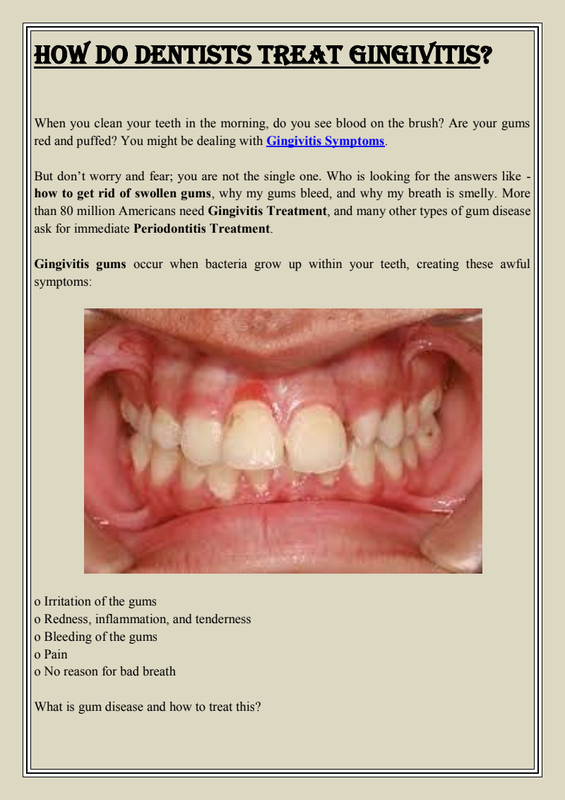
Causes of Gingivitis
Causes may be very varied, ranging from colds, infections to dental disease. When inflammation of the lining of the mouth, should proceed to the use of mash and decoctions. Very effective in the treatment of helpers are chamomile flowers, sage leaves, leafy stems, leaf blueberry, and marshmallow roots.
Symptoms of Gingivitis
Typical Gingivitis Symptoms are red, swollen gums tender, which could bleed on brushing. Another sign is receding gums, which are moving away from the teeth. Teeth as unusually elongated. Gingivitis arises pockets, a haven for food residues that form between teeth and gums. Even in the early stages, some people have recurring bad breath or a permanent foul taste in the mouth.
With proper oral hygiene, gingivitis can be arrested. This means cleaning to remove accumulated plaque and tartar that only a dentist can do. At home, one must floss, preferably after every meal, and brush twice a day. Avoid tobacco and eat nutritious meals. Regular dental checkups are essential.
When to see a doctor
- Do not take lightly signs of gingivitis- otherwise, you risk serious illness of tissue around the teeth and the next stage of tooth loss.-The most serious signs of gingivitis- if you suffer from, as soon as possible to subscribe to the dentist:- Unpleasantly odorous breath, which does not disappear after 24 hours.
- You feel that you lengthen teeth
- When closing the mouth feel different levels of tooth position.
- Between the teeth and gums are called pus pockets
- Teeth will move or fall out

- Makes teeth resistant to decay.
- Inhibits the ability of oral bacteria to produce acid-reactive.
- Promotes re-mineralization of teeth.

How to cure gingivitis?
Plaque and tartar are removed in the gingivitis treatment and it is known as scaling. If the tartar build-up is extensive or the gums are very sensitive then this can be uncomfortable. With more frequent cleanings if necessary, follow-up appointments may be recommended.
Article Source : https://jeffreylinda.blogspot.com/2021/07/how-to-get-rid-of-gingivitis.html